Next.js ships November security fixes
The release fixes seven advisories, and most are bugs in Cache Components.

Update to Next.js 16.4.5 or 15.5.29, whichever line you use. The post is worth reading in full because the fixes touch caching behavior.
Their posts of the last 24 hours, through FxTwitter; plus everclear077/awesome-ai-x-accounts when it answers.
What tech Twitter is discussing, ranked by discussion.
The front page, plus stories over 80 points in the last 24 hours.
Every new issue, each delivered once, looking back up to 7 days.
 VercelChat agents draw their own UIVercel says generative UI in chat will become a main way people talk to agents.» Page 4
 Agent memoryClaude learns by 'dreaming'A new engineering post says the dreaming step organizes what Claude learned and fixes its mistakes.» Page 6
Pergent
The tech daily written for one reader
Saturday, November 7, 2026No. 54Price: $0.05
The release fixes seven advisories, and most are bugs in Cache Components.
Update to Next.js 16.4.5 or 15.5.29, whichever line you use. The post is worth reading in full because the fixes touch caching behavior.

Set outputStyle to Concise in settings.json, or pick it under /config, for short answers you can expand on request.
A dev-only SDK and MCP server lets coding agents drive your running app and return a pass, fail or can't-tell verdict.
Use clientData ?? serverData so refetches stop wiping user edits, instead of a useEffect.

Kent C. Dodds says architecture decision records (ADRs) stop agents from breaking big choices, because they read them.

EnvOpt changes the shared workspace an agent sees instead of its prompt, and lifts Haiku 4.5's pass rate by 14.34%.

Users get some of Muse Wonder's frontier skills on complex, multi-step tasks.
Meta is bringing specialized models built on Muse Wonder to Muse and Meta AI. Active Memory tracks which earlier facts still matter, and Active Focus helps recover when a plan hits a setback.
Terminals
Mitchell Hashimoto says hundreds of projects already use it, reaching tens of millions of people.
Version 1.0 promises a stable binary interface and invites Linux distributions to start packaging it. JetBrains and Neovim are named among its users in the post.
The OpenCode team says its lead agent hands work to cheaper subagents and checks their proof.
thdxr, from the OpenCode team, says the argument about what a software factory is misses the point: show something that ships. His team runs Opus as the lead, sends scoped tasks to DeepSeek subagents, and asks for proof of work instead of a summary.
Privacy phones
A public compatibility report lists the bank's app as blocking non-Google Android, including GrapheneOS.
The bank ASN, from the Netherlands, is said to block its app on non-Google Android builds. The GitHub report that flagged it drew a long Hacker News thread of over 400 comments, most about whether banks should lock out privacy-focused phones.
Open models

The lab's own test cut propaganda-style answers from 22% to 1%.
Nous Research says it fine-tuned Qwen3.8-27B on about 53 million tokens. Its 803-prompt test across seven value areas, including free speech and democracy, reports no big loss on its Hermes Bench score. The post drew 769 replies, but the files do not show what critics said, so this is the lab's claim, not an outside check.
Vercel says generative UI in chat will become a main way people talk to agents.
Vercel's AI SDK, Chat SDK and json-render turn an LLM's output into real UI pieces. Those pieces show up inside Slack and Teams. Guillermo Rauch (@rauchg) calls it a likely main pattern for human-agent work.
Vercel and Next.js

Hobby teams must migrate by November 29, and the new prices charge per read and write.
Vercel is folding Next.js's Data Cache into its Runtime Cache. Allocations get bigger, but every read and write now has its own price. Check your own usage before you move, because the new pricing is the part that can surprise you.
Redux
Mark Erikson expects RTK 3.0 in six to eight months, with 2.14 shipping this week as groundwork.
The roadmap goes ESM-only, meaning it drops the older module format, with breaking changes on the scale of React 19. A run of 2.x releases will prepare the ground first.
Web security

Scott Helme counts 15,579 known-infected sites and asks how to warn their owners.
The post asks the hard question: once you know a site is infected, how do you reach its owner at scale? It drew a busy Hacker News thread.
Infrastructure

GitHub's engineering blog explains the new storage design behind every repository.
The post walks through a new architecture for storing Git data, a big change behind the scenes of every repo on the platform. The Hacker News thread on it is short but thoughtful.
Next.js
An experimental merged change runs route code in Go-powered workers.
A route can now be a route.go file that exports GET and friends. Turbopack compiles it and supervised Go workers run it. Tim Neutkens says Rust could follow the same path.
Website migration
His page speed score rose from 52 to 75 after the move.
Bos moved 307 posts, 6.7 GB of photos, four custom content types and 15 custom fields to Emdash. He ended a $600 Bluehost server he had paid for over 15 years.
Security
The write-up is PwnEscape Part 2 and drew over 100 comments on Hacker News.
A security post shows another way to break out of a Firecracker sandbox. The thread is busy with questions about how safe cloud sandboxes really are.
Faster text layout and native module calls, legacy bridge APIs gone. Stable is expected in December.

Give it sample data and it renders your real component invisibly, then draws a matching skeleton.
Cursor
Apps only go live when a user publishes them, and team admins can take them offline.
Build Live Apps builds a web app from a prompt, with hosting, sign-in and optional Postgres on paid plans. Security checks look for common problems such as exposed credentials, but they do not promise a bug-free app.
Agent safety
Primcloud's founder says the agents tried to pull customer secrets, but the attempts were blocked.
A Railway engineer used AI agents to sign up for and test rival cloud services. Railway's CEO apologized and said it will ban external automated testing, and the engineer says he halted the framework.
AI fraud
Prosecutors say thousands of companies were targeted over 18 months; the charges are unproven.
US prosecutors in New York say emails and calls copied CEOs, then a fake lawyer sent wire instructions. Targeted firms are not the same as firms that paid.
A new engineering post says the dreaming step organizes what Claude learned and fixes its mistakes.
Anthropic's engineering blog describes how dreaming helps Claude sort what it has learned and find it faster next time. Omar Saravia (@omarsar0) says the best memory setups mix plain folders with a simple episodic store.
Agent memory

A distilled model scores 59.9% on user-fact recall, beating retrieval at 47.8%.
Amazon researchers show that a model can keep user facts in its weights, not only in saved text it fetches. On eight HaluMem-Long users, the distilled model answered with no retrieved context and still beat the retrieval setups.
Open weights
It cuts thinking tokens by 54% and lifts GPQA Diamond by 3%, the team says.
A new team open-sourced Qwen Concept 27B, its first model. It edits weights directly, and weights in BF16, FP8 and NVFP4 are promised free.
Hugging Face

Each agent harness gets its own small adapter on the same base model, and early tests show fewer failures.
The team trains small adapters with RL inside each agent setup, such as pi, opencode and Hermes. Thom Wolf makes the same point: the same open model gives very different results in a different harness.
Open models

A 27B open model lands within 1.6 points of Claude Opus 5.5 on one test, at 183 ms instead of 3.5 seconds.
Nace AI released Drex, four open decision models from 8B to 27B. You give it a state and fixed options, and it returns probabilities without writing text. Shreya Shankar argues that prefill-only endpoints are a fairer price for these workloads.
LLM judges

Hightouch says a small model that calls Opus on hard cases matches Opus at about a quarter of the cost.
Hightouch's post shows the pattern for identity resolution, which means matching records that refer to the same person or company. It was one of the most-discussed posts on Hacker News today.
Rauch says teams should capture production traces and optimize from real use.
Guillermo Rauch (@rauchg) agrees with @bcherny that coding is solved but bugs are not. He argues you can now build anything, so the next gains come from watching how software is used in production.
AI progress
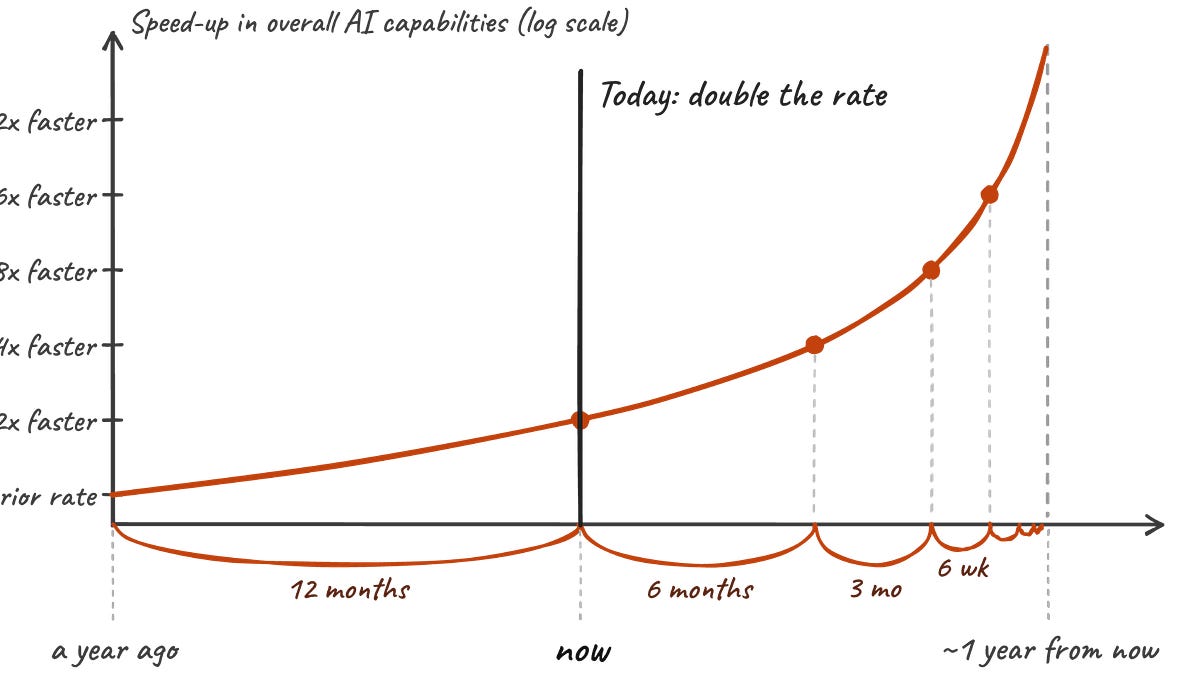
The essay says AI is already dramatically speeding up the research that builds AI.
A Planned Obsolescence essay argues AI is already doing much of the work of AI research. Nathan Lambert (@natolambert) ties the same theme to a METR report and says coding agents and inference compute change how labs work.